2 min
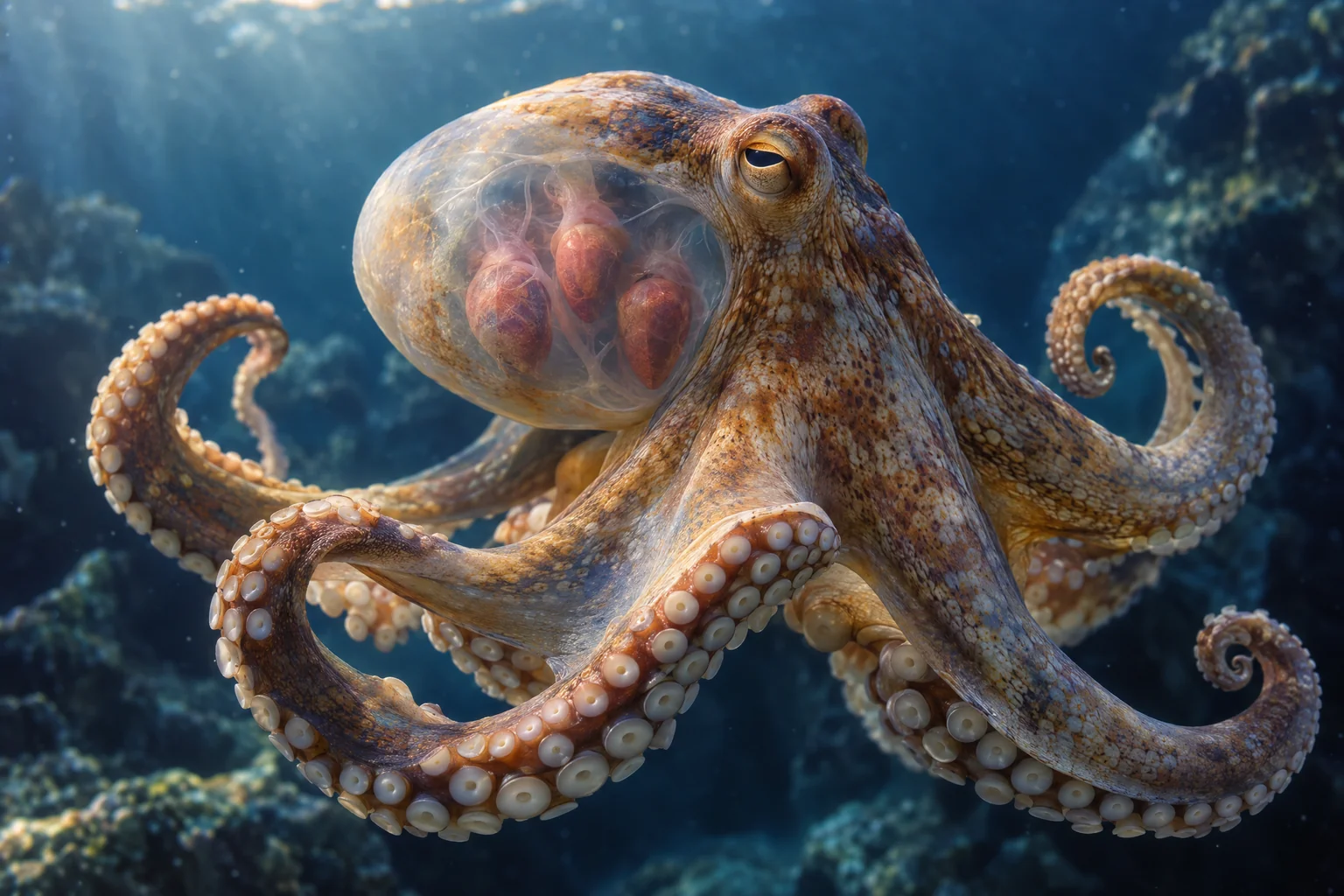
Why do octopuses have three hearts and blue blood?
Two of the hearts pump blood to the gills to pick up oxygen; the third pumps it around the body. The blood is blue because octopuses carry oxygen with copper instead of iron.
Answer
Start with the three hearts. Inside an octopus the work is split very cleanly. Two of them are called branchial hearts, and their only job is to push blood through the gills to pick up oxygen. The third, the systemic heart, sends that oxygen-rich blood around the rest of the body. It sounds generous, but there is a catch: the systemic heart has the hardest job of the three.
Why is the blood blue? Because octopuses do not use iron — they use copper. Human blood carries oxygen with haemoglobin, which contains iron and looks red. Octopuses use haemocyanin, which contains copper and turns blue when it carries oxygen. Haemocyanin works better in cold, low-oxygen water, which makes it a smart choice for a cold-sea animal.
Here is the most surprising part. That hardest-working heart stops beating while the octopus swims. Pumping is already expensive, and swimming squeezes the body, so the heart simply takes a break. That is why octopuses prefer to crawl or to jet along rather than swim for long — swim too long and they run short of oxygen.
In one line: three hearts and blue blood are all about living comfortably in cold water, and the heart that stops when it swims is the price of that design.
A stranger fact: octopuses are cephalopods, and their circulation is only "semi-closed". Blood is not fully sealed inside vessels — some of it spills into open spaces called sinuses, which makes the systemic heart even less efficient.
Michael's Thought
Its heart stops while it swims. That might be the most confusing animal design I have ever heard. It would rather crawl than get tired.
Sources
Related WHYS
Why do cats almost always land on their feet?
Cats flip in mid-air not because they have nine lives, but by splitting one turn into two: 90° with the front half, 10° the other way with the back. And the idea that higher floors are safer is a statistical trap.

Why do zebras have stripes?
Zebra stripes are usually explained as camouflage, but a 2014 global study found almost no link between stripes and predators — while stripes matched the map of biting flies almost perfectly. The best-supported idea today: stripes keep flies from landing.

Why do dogs have wet noses?
That slimy layer is not a health sign — it is a sticky net that traps smell molecules. A 2020 study even found a dog's cool nose can sense weak heat from 1.5 metres away.