4 min
Why do cats almost always land on their feet?
Cats flip in mid-air not because they have nine lives, but by splitting one turn into two: 90° with the front half, 10° the other way with the back. And the idea that higher floors are safer is a statistical trap.
Answer
First, picture it
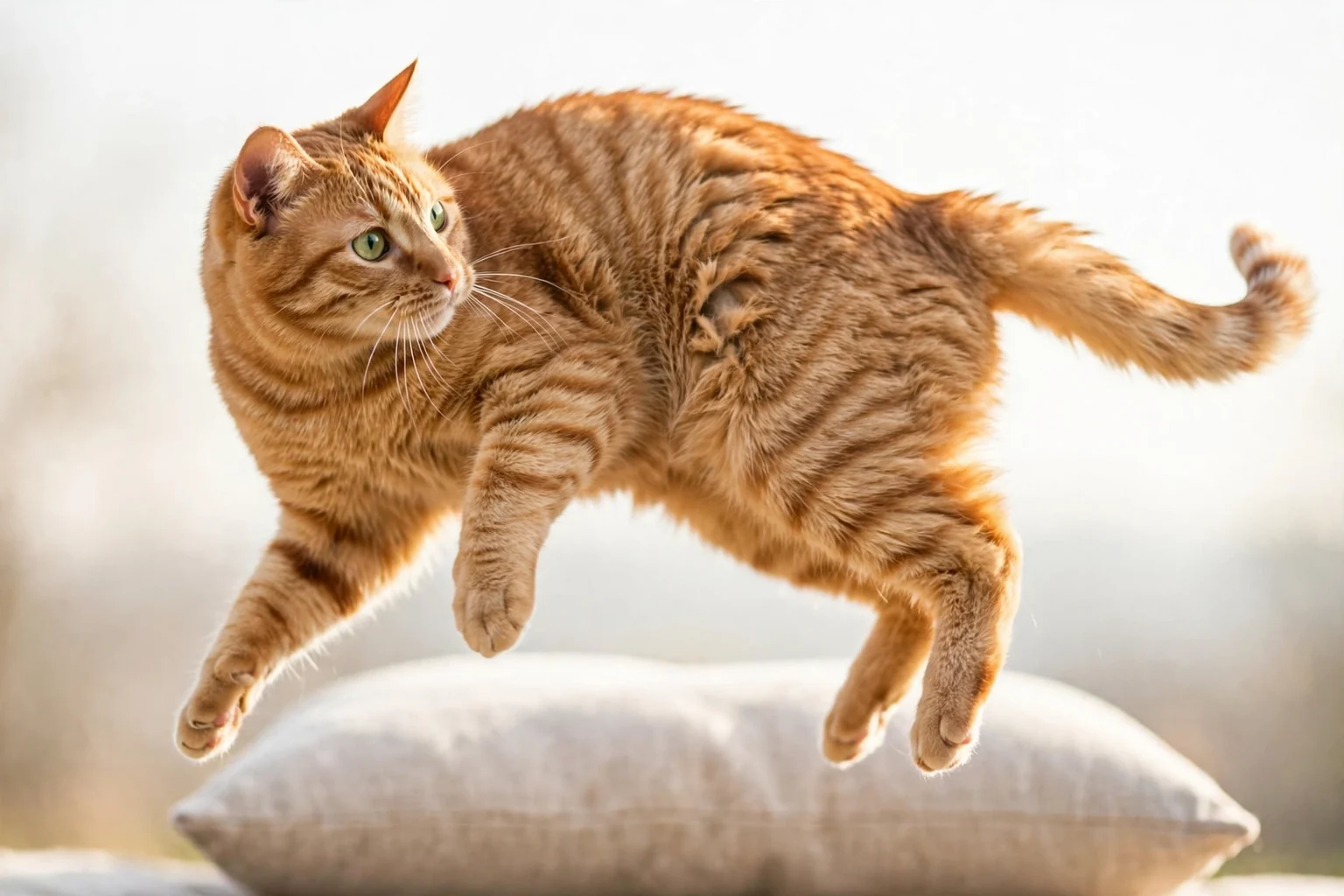
Drop a cat from a low height (please don't actually try this with a cat). For a moment it looks like someone twists it in mid-air: the head turns first, then the front paws point down, then the back legs spread out — and it lands on its feet.
There is nothing to push against
Here is the problem. In the air there is no floor to push off and nothing to grab. So a cat cannot simply "paddle" itself around the way you paddle in water.
Physics has a strict rule called conservation of angular momentum: if nothing outside is twisting you, the total amount of spin in your body has to stay the same. In plain words, if a cat turns its front half one way, the back half must turn the other way a little. The books always have to balance to zero.
So it pays in two instalments
How does it still manage a full 180°? By splitting the turn into two smaller turns.
- Work out which way is down. Eyes help, and so does the vestibular system in the inner ear, which senses gravity.
- Fold the body in half. Bending at the waist lets the front half and the back half spin around different axes, so each can move without dragging the other.
- Tuck the front legs, stretch the back legs. Tucked legs spin fast; stretched legs spin slowly. So the front half can turn 90° while the back half turns only 10° the other way.
- Swap and repeat. Now the back half catches up with the rest.
Two turns add up to 180°, and the total is still zero. This is called the righting reflex.
Why cats can do it
A cat's spine is extremely flexible, its collarbone is so reduced that it barely does anything, and its front legs can fold in very close to the body. The skill is not learned: kittens start doing it at 3–4 weeks and have it mastered by 6–9 weeks. A tail helps, but cats without tails can still right themselves.
But "cats always land safely" is a myth
A 1987 study of 132 cats reported that injuries got worse with height up to the seventh floor, and then got better. That sounds like "higher is safer", but critics point out it is survivorship bias: cats killed instantly never get taken to a vet. A 2003 study of 119 cats found the opposite — falls from the seventh floor or higher caused more severe injuries and more chest trauma.
A cat does not have nine lives. It is just very good at arithmetic.
Try it yourself
Take an old soft toy (not a cat) and stick two paper arrows on its back, one pointing forward and one pointing back. Drop it from about half a metre and film it in slow motion. You will see that the toy does not spin as a whole — that is conservation of angular momentum in action. A real cat can flip because it splits its body into two parts and turns them one at a time.
Michael's Thought
I always thought cats have nine lives, and that's why they dare to jump off the wardrobe. Now I know better: it's not that they aren't scared of falling. They're just doing very careful maths in mid-air — 90 degrees here, 90 degrees there, and the total always comes out as zero.
Sources
Related WHYS

Why do zebras have stripes?
Zebra stripes are usually explained as camouflage, but a 2014 global study found almost no link between stripes and predators — while stripes matched the map of biting flies almost perfectly. The best-supported idea today: stripes keep flies from landing.

Why do dogs have wet noses?
That slimy layer is not a health sign — it is a sticky net that traps smell molecules. A 2020 study even found a dog's cool nose can sense weak heat from 1.5 metres away.
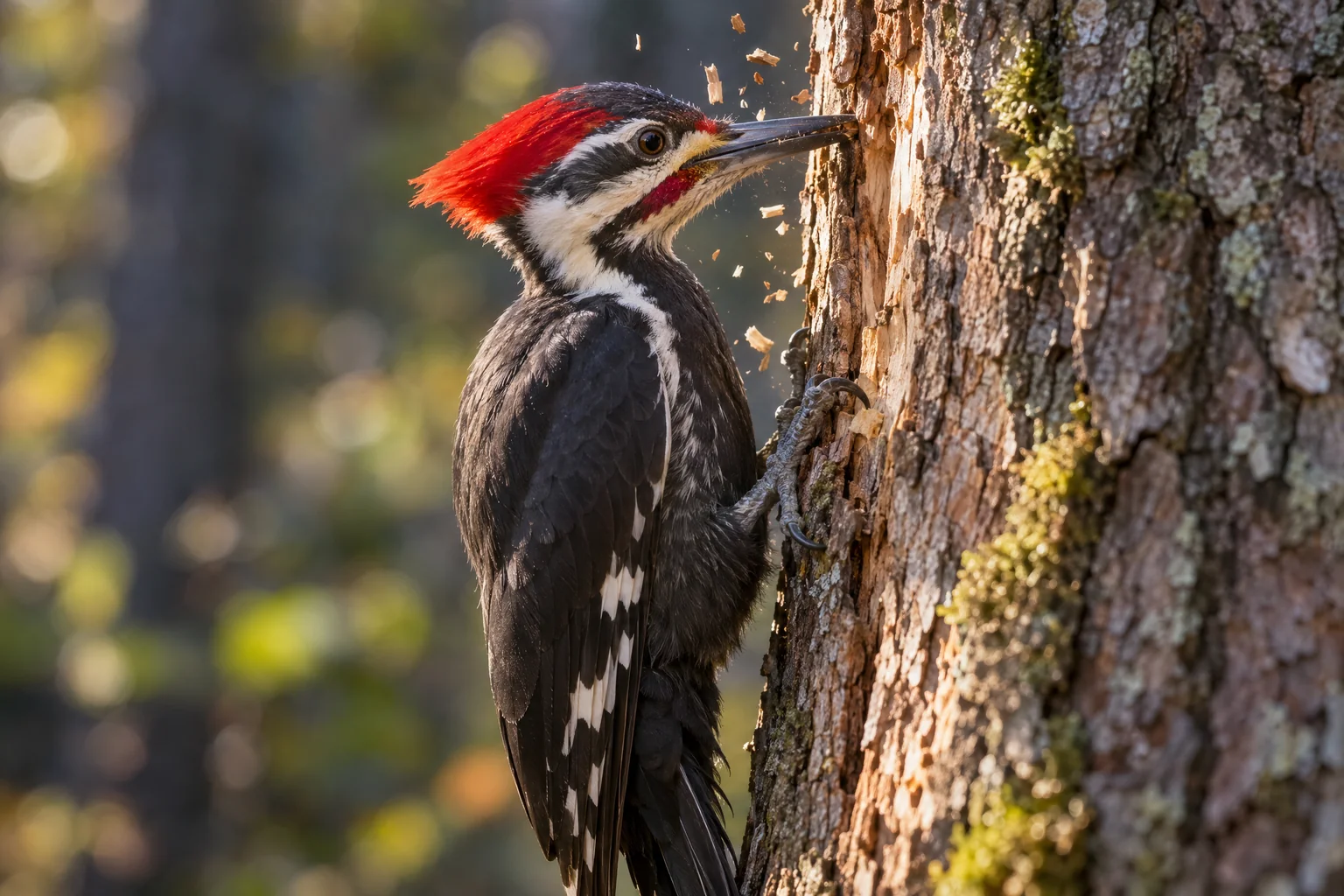
Why don't woodpeckers get brain damage from pecking?
A woodpecker hammers a tree 15 to 20 times a second, thousands of times a day, and each hit slows its head down by about 1000 g. Textbooks said its skull is a shock absorber. A 2022 study found the opposite: it survives by being stiff, not soft.