2 min
If there are countless stars, why is the night sky dark?
Slice the universe into shells of equal thickness and the sky should blaze like the Sun's surface. It doesn't — and the answer lies in the universe's age and its expansion.
Answer
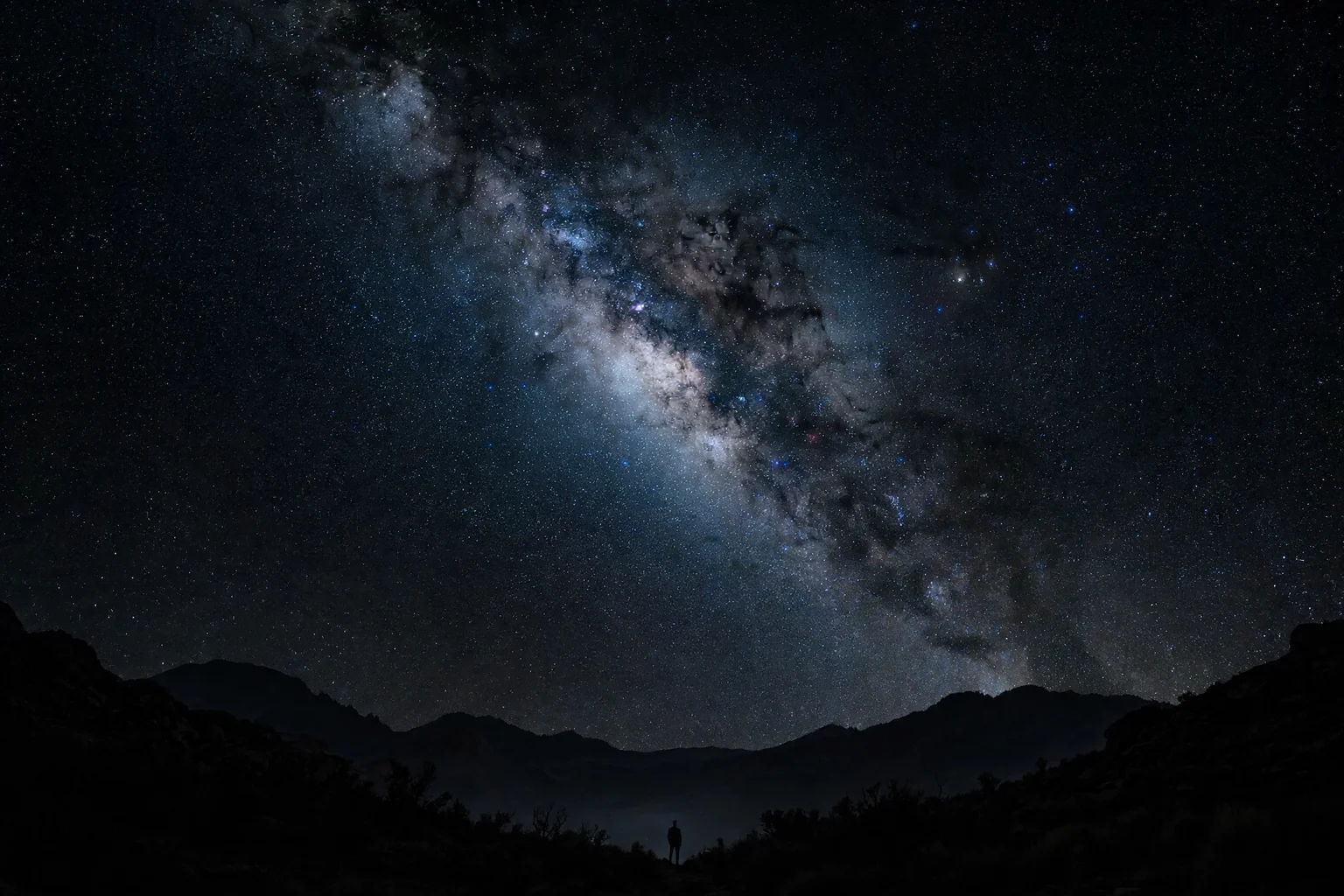
Look up at the night sky. It is dark and quiet. But here is a puzzle: if the universe were infinite, forever old, and filled with stars in every direction, the sky should not be dark at all. This puzzle is called Olbers' paradox.
Let's do the math. Imagine the universe as layers of onion shells, all the same thickness. In a shell twice as far away, there are four times as many stars, but each one looks four times dimmer. The two effects cancel out: every shell sends us the same amount of light. With infinite shells, the light adds up forever, and the whole sky should glow as bright as the surface of the Sun.
So why is it dark? There are two answers. First, the universe is only about 13.8 billion years old. Light is fast, but it has only had that long to travel. Starlight from very far away is still on its way — not dim, just not here yet. Second, space itself is stretching. As light travels, its waves get stretched too. This is called redshift. Visible light from the farthest sources is stretched into microwaves, and we receive it as the cosmic microwave background at about 2.7 kelvin — a faint glow covering the whole sky that our eyes cannot see.
What about dust blocking the light? That does not work either. Dust would absorb the light, heat up, and then glow again itself. The sky would still be bright.
The best part: in 1848, the writer Edgar Allan Poe explained the answer in a prose poem called Eureka — ten years before scientists published it properly.
Try this: at night, shine a torch on a wall from close up, then walk to the other side of the room and shine it again. Twice the distance means one quarter of the brightness. That is exactly the trade that makes every shell of the universe add up to the same light.
Michael's Thought
So the dark isn't empty. Some starlight is still on its way — I just got here first.
Sources
Related WHYS
Why does Greenland look as big as Africa on a world map?
On a world map, Greenland looks almost as big as Africa. In reality Africa is 14 times larger. The map is not misprinted — it is a trade-off made so sailors never have to turn.

Why is writing backwards in a mirror? — And the direction a mirror flips isn't left-right at all
A mirror only reverses the axis pointing straight out of the glass — front to back. The famous left-right flip is not optics at all; it is a story our brain writes.
Why are airplane windows always round? — the "square window" crash story mixed up two different windows
The popular story says square windows doomed the de Havilland Comet in 1954, so airliners switched to round ones. Wikipedia debunks it: the crack started at a radio-antenna cut-out, not the passenger windows.