2 min
Why do snowflakes always have six sides?
Snowflakes almost always have six sides, yet no two look alike. The six comes from the hexagonal skeleton of ice; the difference comes from the path each flake takes on the way down.

Answer
Next time it snows, catch a snowflake and look at it through a magnifier. It will almost certainly have six sides, like a tiny six-pointed star. Yet no two snowflakes ever look exactly the same. So why is the number of sides always stuck at six?
The answer is in the way water molecules line up. A water molecule is one oxygen atom plus two hydrogen atoms. When water freezes into ice, each molecule reaches out with hydrogen bonds and grabs four neighbours, arranging itself into neat six-sided layers. This pattern is called the hexagonal crystal system. Ice is born with a six-sided skeleton, so a crystal growing out of it can only reach out in six directions.
A snowflake starts as a very small hexagon. Its six corners grow outward into six arms (scientists call them dendrites), and each arm grows smaller branches of its own. As the flake falls, all six arms pass through almost the same temperature and humidity, so they end up looking nearly symmetrical.
Then why is every flake different? Because every flake takes a slightly different route from the cloud to the ground. A little warmer and it grows as a flat plate; a little colder and it grows as a thin needle. NOAA records that around −15°C you mostly get flat plates, while around −5°C you are more likely to get needles. Different route, different result — but the six-sided base never changes.
Try it yourself: Put a sheet of black card in the freezer for an hour, then take it out and look at it through a magnifier in the light. That white frost is made of ice crystals, and if you are lucky you will spot hexagons and needles. For a clearer view, sandwich a single drop of water between two glass slides, put it back in the freezer, and watch the crystals creep in from the edges.
In one line: nobody cuts snowflakes into six sides — water molecules simply refuse to line up any other way.
Michael's Thought
I always thought snowflakes had six sides because something cut them that way. It turns out the water molecules just refuse to line up any other way.
Sources
Related WHYS
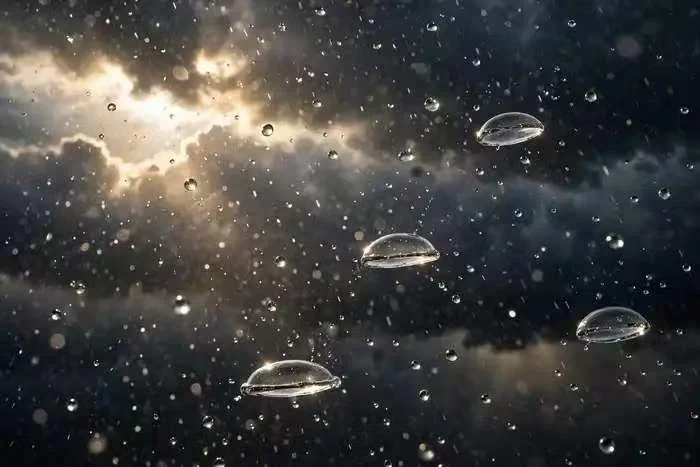
What does a raindrop really look like as it falls?
The teardrop we all draw has never actually fallen from the sky. Small raindrops are nearly perfect balls; bigger ones get squashed by the air into something like a hamburger bun.

Why is lightning zigzagged instead of a straight line?
Lightning is a crooked, branching path. Because air does not conduct, charge has to feel its way forward one short step at a time. The bright flash we see is actually the return stroke racing back along the path already carved out.

Why does the ground smell so good after it rains?
Rain has no smell of its own. That 'rainy' scent is oil stored in the soil during dry spells, blasted into the air by popping bubbles — starring geosmin, a molecule made by soil bacteria.