2 min
Why are pyramids triangular?
Stone is strong when you squash it and weak when you stretch it — that is why pyramids are triangular. And the famous 51°50' angle was not calculated; Pharaoh Sneferu earned it by rebuilding two earlier pyramids.
Answer
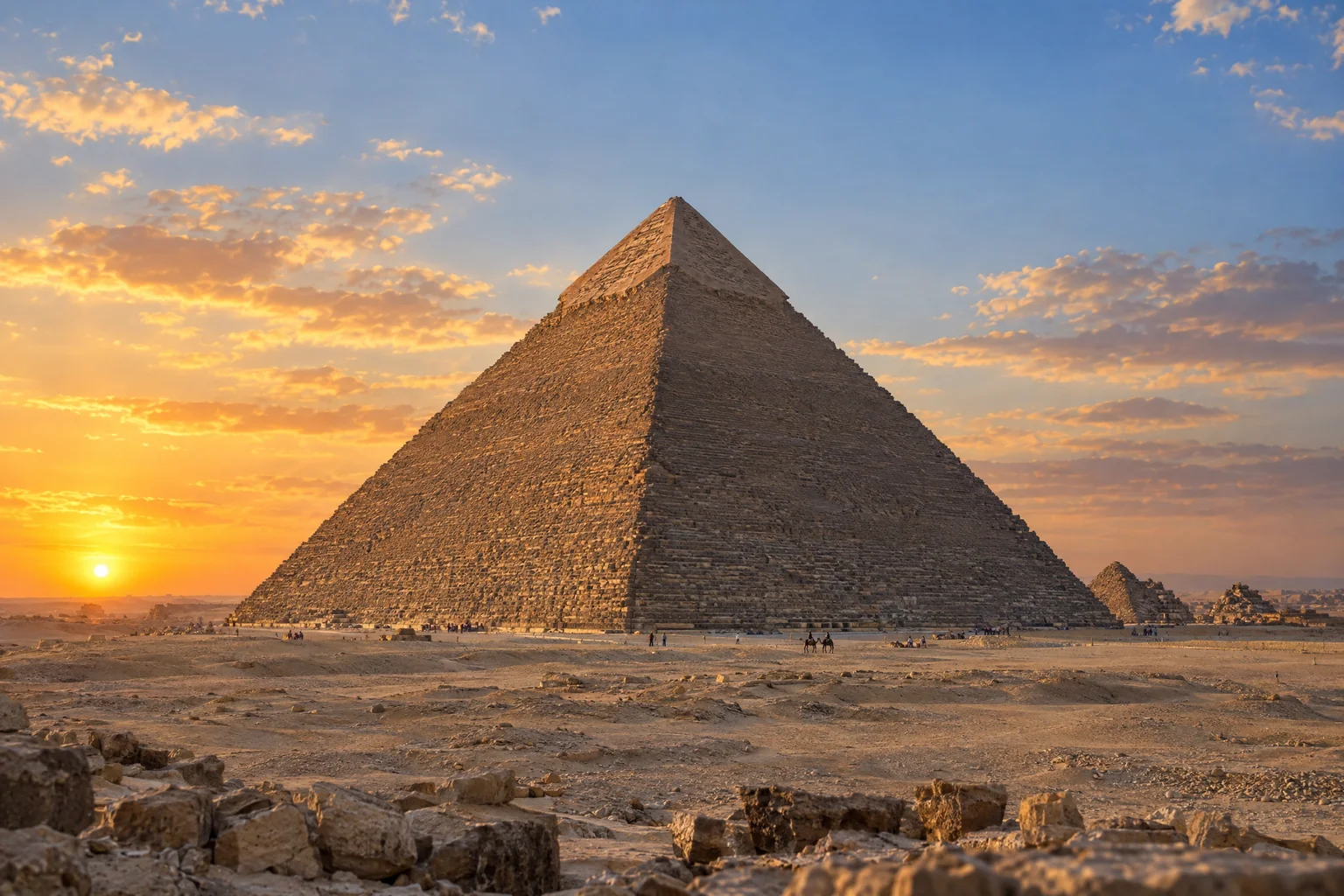
Stand in front of the Great Pyramid at Giza and you see four huge triangles, tilted up until they meet at a single point.
Why not build a square tower instead? Because stone is strong when you squash it, and weak when you stretch it.
Press down on a stone and it holds firm. Try to pull it apart from both ends and it snaps. So if you are building with stone, the clever move is to make sure every block is being squashed and never stretched.
A pyramid does exactly that. It is a four-sided cone: a huge base, a very low centre of gravity, sitting safely inside that base. Push it and it will not tip over. Even better, the cone shape passes the weight downwards, layer by layer — each block mostly carries the weight of the blocks above it, so almost nothing gets stretched. Build a column or a wall instead, and some parts are bound to be pulled apart. Stone cracks when it is pulled.
Here is the surprising part: nobody calculated that angle. They tried it.
Pharaoh Sneferu started building at Dahshur, going up at 54°27'. Halfway up, something went wrong, so the builders flattened the top to 43°22' — and the pyramid still has a visible kink today. We call it the Bent Pyramid. His next one, the Red Pyramid, used 43° from the ground up. Then his son Khufu settled on 51°50' for the Great Pyramid: 146.6 metres tall, 230 metres along each base side, with the four sides averaging only 58 millimetres of error. Four and a half thousand years later, it has sunk just a few centimetres.
Try it yourself: stand four thick books in a square, lay a stiff piece of card on top, then put a dictionary on the card. The card sags. Now move the books into a triangle and try again — the card holds much better. A triangle is the shape that refuses to be pushed out of shape, and the pyramid uses that trick at the scale of a 146-metre-tall building.
Michael's Thought
I always thought the pyramid angle was calculated. It turns out they found it by getting it wrong first. Maybe a lot of "right answers" are just the ones somebody else already failed their way into.
Sources
Related WHYS

Why do barbershops have a red, white and blue spinning pole?
That spinning pole outside a barbershop is not decoration. It is the old sign of a barber-surgeon: the pole is the stick the patient gripped, the top basin held leeches, and the bottom one caught the blood.

Why do coins have ridged edges?
Those tiny ridges on a coin's edge are not decoration. Long ago a coin was worth the metal inside it, so people shaved silver off the edges and spent the coins anyway. The ridges make any missing metal easy to spot — and the Latin words pressed into the edge literally mean "an ornament and a safeguard".
Why is an hour 60 minutes long, and a day 24 hours?
Twenty-four hours and sixty minutes came from two different ancient civilisations — Egypt's twelve star-groups and Babylon's base-60 counting. A quick bean experiment shows why 60 was so handy.