2 min
Why does Greenland look as big as Africa on a world map?
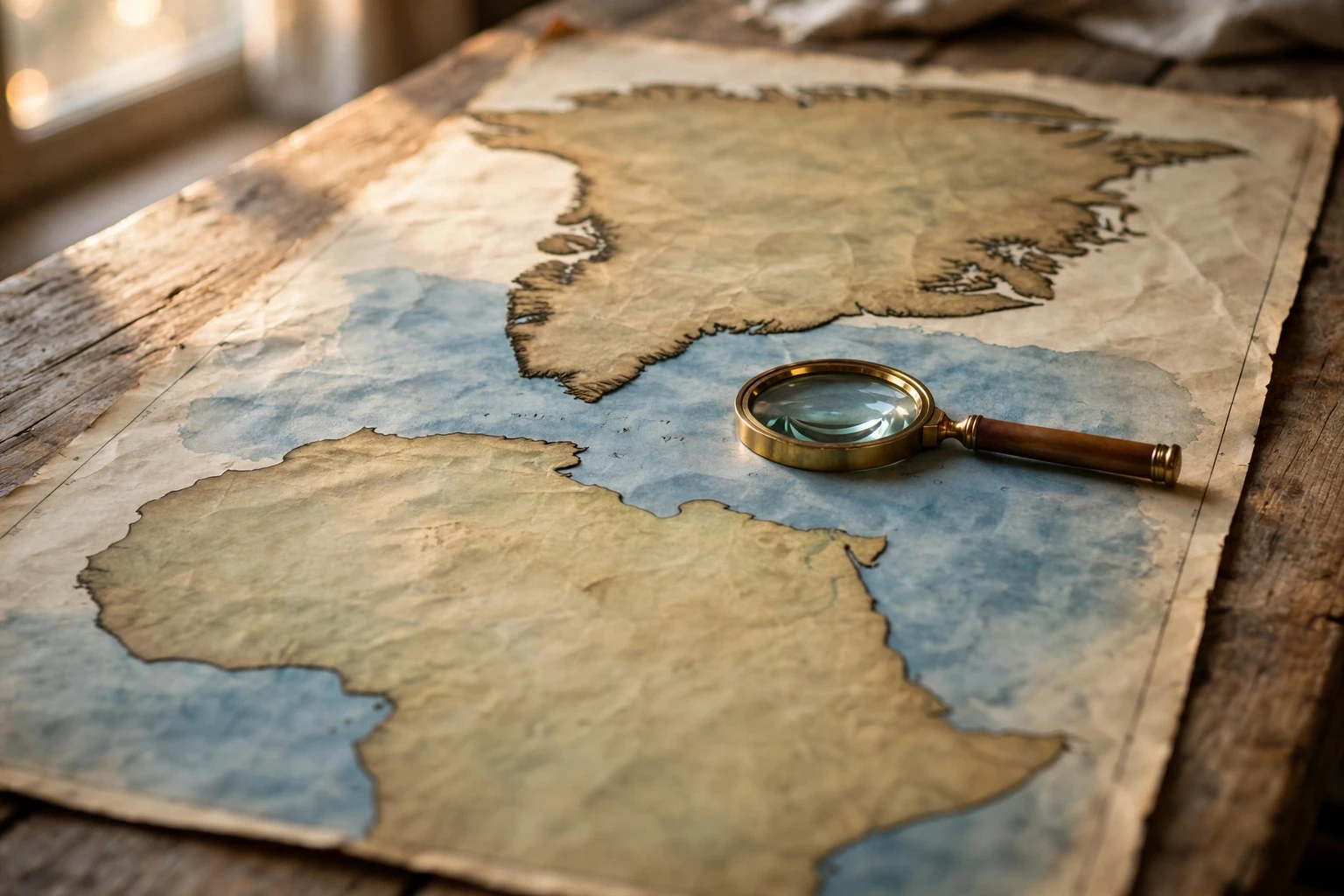
On a world map, Greenland looks almost as big as Africa. In reality Africa is 14 times larger. The map is not misprinted — it is a trade-off made so sailors never have to turn.
Answer
Open a world map. Find Greenland, then find Africa. They look about the same size, right? Now the real numbers: Greenland covers 2.17 million square kilometres, Africa covers 30.37 million — Africa is 14 times bigger. The map is not misprinted. It is telling a lie on purpose.
Earth is a ball and paper is flat. Flattening a ball is like pressing an orange peel onto a table: it has to crack, or it has to bunch up. So every world map must give something up — shape, area, or direction. You cannot keep all three.
In 1569 a mapmaker named Gerardus Mercator chose to keep shape. On his map, every small patch of land keeps its outline. The price is that sizes grow as you move away from the equator: normal at the equator, 4 times too big at 60 degrees, about 33 times too big at 80 degrees. Greenland sits between 59 and 83 degrees north, right inside that zone.
Why pay such a price? Because on this map, a ship that keeps the same compass bearing draws a straight line. Sailors did not need to solve hard spherical maths. They laid down a ruler, followed the line, and they always arrived — not by the shortest route, but they arrived.
So the Mercator map is not a wrong map. It is a map built for direction. And it is honest about its cost: the poles stretch to infinity, which is why phone maps simply cut off at 85.05 degrees north and south.
Try it yourself: peel an orange in one piece and try to flatten the peel on the table. It will not lie flat — it cracks or it folds. That is where every map begins.
Michael's Thought
I used to think a map was a photo of Earth. Now it feels more like a sketch that traded the truth about size for the truth about direction.
Sources
Related WHYS

Why is writing backwards in a mirror? — And the direction a mirror flips isn't left-right at all
A mirror only reverses the axis pointing straight out of the glass — front to back. The famous left-right flip is not optics at all; it is a story our brain writes.
If there are countless stars, why is the night sky dark?
Slice the universe into shells of equal thickness and the sky should blaze like the Sun's surface. It doesn't — and the answer lies in the universe's age and its expansion.
Why are airplane windows always round? — the "square window" crash story mixed up two different windows
The popular story says square windows doomed the de Havilland Comet in 1954, so airliners switched to round ones. Wikipedia debunks it: the crack started at a radio-antenna cut-out, not the passenger windows.