3 min
Why Does Ice Float on Water — When Almost Every Other Solid Sinks in Its Own Liquid?
Water expands by about 9% when it freezes, so ice is lighter than water. The secret is a hexagonal net of hydrogen bonds — and it's also why fish survive winter.
Answer
Drop an iron block into liquid iron, and it sinks. Drop a piece of wax into melted wax, and it sinks too. Almost every substance works this way: when a liquid turns into a solid, its molecules pack more tightly, so the solid gets heavier than the liquid.
Water doesn't work this way. Ice is about 8.3% lighter than water — the same amount of water takes up about 9% more space when it freezes. That's why ice cubes float in your drink and icebergs float in the sea.
The secret is the shape of a water molecule.
A water molecule is shaped like a V: one oxygen atom in the middle, two hydrogen atoms at the tips. The oxygen atom is greedy for electrons, so it pulls the electrons away from the hydrogens. Now the oxygen end has a negative charge and the hydrogen ends have a positive charge. One water molecule's positive end attracts another molecule's negative end — this pull is called a hydrogen bond.
In liquid water, the molecules zip around, hydrogen bonds keep snapping and re-forming, and the molecules can pack tightly together. But when the temperature drops to 0°C, the molecules get so slow they can barely move. Now the hydrogen bonds lock each molecule to four neighbours, building a three-dimensional net of hexagons.
And here's the catch: the middle of every hexagon is empty space. The molecules are locked in place, but they take up more room than when they were squished together. So the same molecules now fill about 9% more space, and the density drops to 0.917 g/cm³ — ice gets "puffed up" and lighter.
This oddity saves a lot of lives.
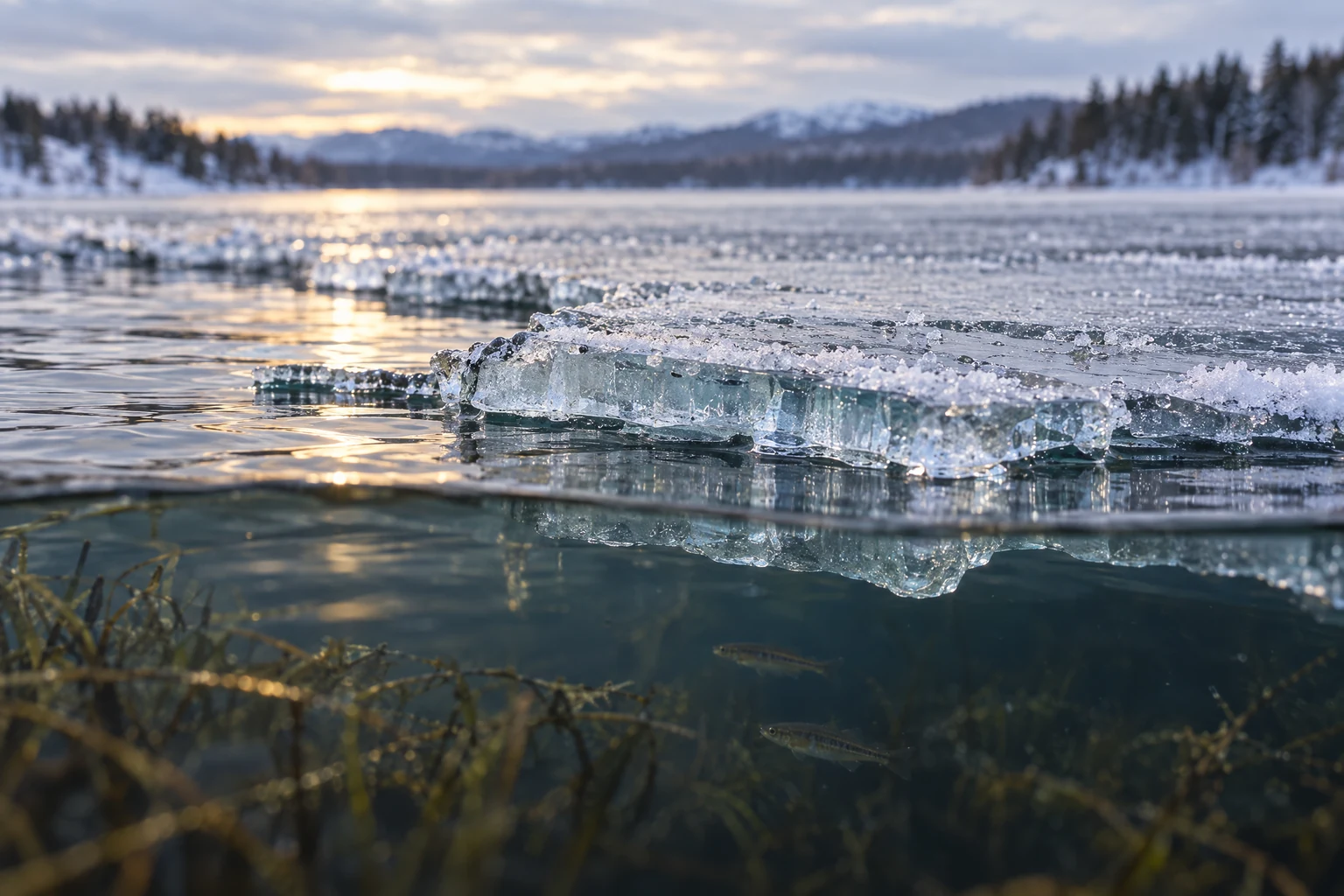
If ice were heavier than water, the ice that forms on a lake in winter would sink to the bottom, pile up, and freeze the lake solid from the bottom up. Every fish and plant would die. Instead, ice is lighter, so it floats on top like a blanket over the water. Underneath, the water stays liquid, and the very bottom is the warmest spot. The fish huddle in this layer of living water and survive the whole winter.
Next time you see an ice cube floating in a glass, you can tell everyone: it's not "light" — it's just puffed up by a net of hexagons.
Try it yourself: Take a plastic cup (not a glass one!), fill it nine-tenths full of water, and put it in the freezer. Look at it the next day: the ice will bulge up over the rim and maybe even warp the cup — that's the 9% expansion. Then drop an ice cube into a glass of water and look at how much sticks out: about one tenth, with nine tenths underwater — exactly like an iceberg in the ocean.
Michael's Thought
Ice isn't light, it's just puffed up — and if it weren't, every fish in the lake would be gone.
Sources
Related WHYS
Why does Greenland look as big as Africa on a world map?
On a world map, Greenland looks almost as big as Africa. In reality Africa is 14 times larger. The map is not misprinted — it is a trade-off made so sailors never have to turn.

Why is writing backwards in a mirror? — And the direction a mirror flips isn't left-right at all
A mirror only reverses the axis pointing straight out of the glass — front to back. The famous left-right flip is not optics at all; it is a story our brain writes.
If there are countless stars, why is the night sky dark?
Slice the universe into shells of equal thickness and the sky should blaze like the Sun's surface. It doesn't — and the answer lies in the universe's age and its expansion.