3 min
Why do coins have ridged edges?
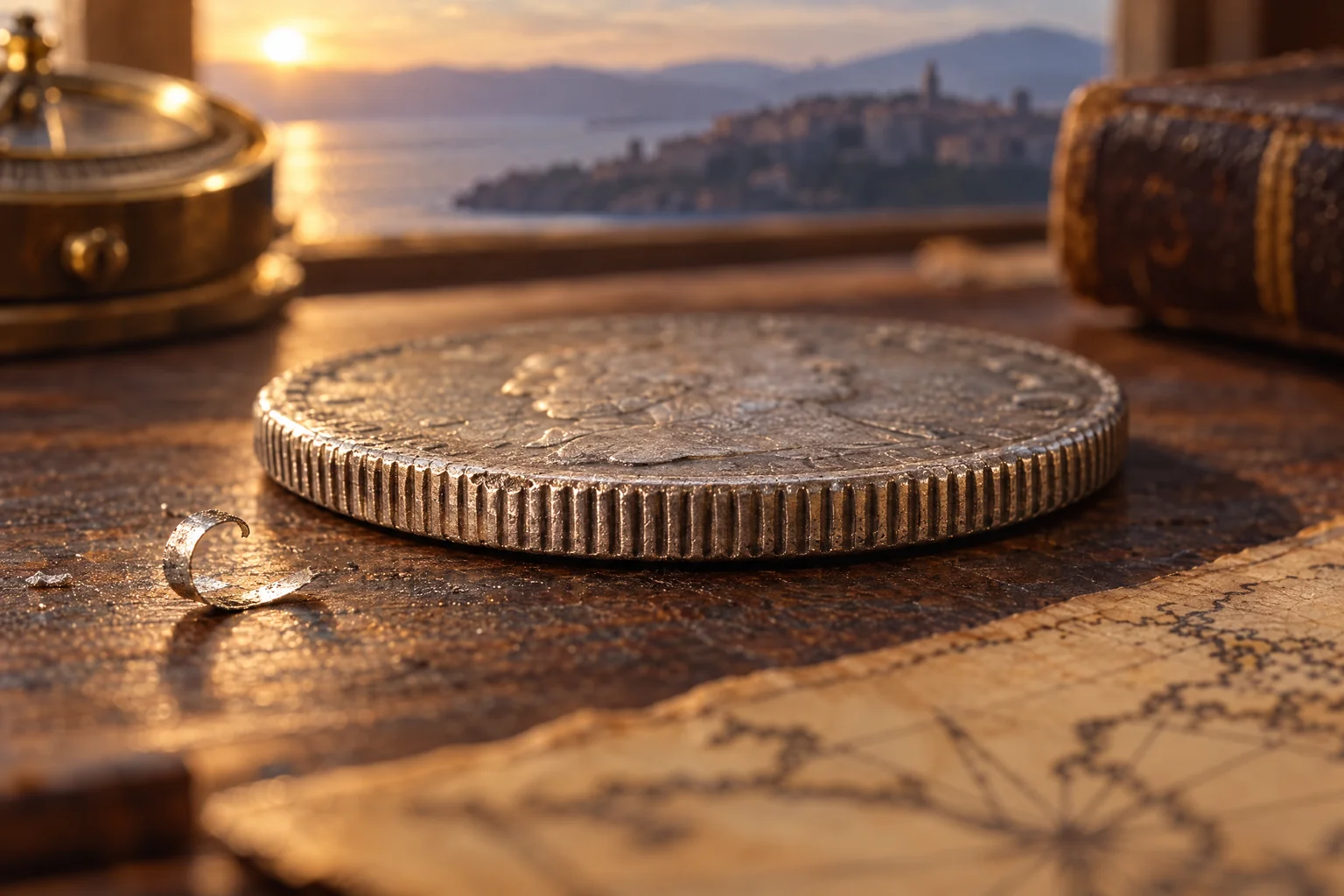
Those tiny ridges on a coin's edge are not decoration. Long ago a coin was worth the metal inside it, so people shaved silver off the edges and spent the coins anyway. The ridges make any missing metal easy to spot — and the Latin words pressed into the edge literally mean "an ornament and a safeguard".
Answer
Why is a coin worth anything?
Before paper money, a silver coin was worth almost exactly the silver inside it. Think of a coin as a lump of silver pressed into a flat circle.
Then someone picked up a pair of scissors
Here is a simple trick. Take scissors and shave a thin curl of silver off the edge of a coin. Save the shavings, melt them into a lump, and sell the silver. Then spend the coin as if nothing happened. People called this clipping, and it was like printing free money.
Worse, it spread. Clipped coins kept moving from hand to hand, while good coins were hidden away and melted down. The money in everyone's pocket got lighter and worse. Economists call this Gresham's law.
How the little ridges fixed it
Around 1550, European coins were still made the old way: a metal blank was hammered between two dies, the same method ancient Greece used. The edges came out rough and uneven, so nobody could tell if a coin had been shaved.
Then machines took over. Coins came out perfectly round and neat, and a ring of tiny ridges was pressed onto the edge. The ridges do one simple job: if anyone shaves off even a little metal, the pattern breaks — and you can see it right away.
In 1662, King Charles II of England brought a French craftsman named Peter Blondeau to the Tower of London mint to make coins by machine, with ridges and lettering on the edge. The letters are Latin: DECVS ET TVTAMEN, a line from Virgil's Aeneid meaning "an ornament and a safeguard". The words say out loud that the edge is both decoration and protection.
In 1698, Isaac Newton — yes, that Newton — was in charge of the Royal Mint, and he pushed the ridged edge further.
But the story does not end perfectly
Ridges stopped clipping, but they did not stop fakes. Counterfeiters simply started making whole fake coins instead of shaving real ones. By 1696, about one coin in ten in England was fake, and the government had to call in all the old coins and make new ones.
Try it yourself
Put a few coins of different values in your pocket. Close your eyes and feel only the edges with your fingertips. Can you tell which coin is which?
Some edges have ridges, some are smooth, and some have words on them. That feeling is not an accident. It is the second job of those little ridges: letting people who cannot see tell the coins apart by touch.
Michael's Thought
I always thought those tiny ridges were just decoration. Turns out people really did take scissors to their money.
Sources
Related WHYS

Why do barbershops have a red, white and blue spinning pole?
That spinning pole outside a barbershop is not decoration. It is the old sign of a barber-surgeon: the pole is the stick the patient gripped, the top basin held leeches, and the bottom one caught the blood.

Why is an hour 60 minutes long, and a day 24 hours?
Twenty-four hours and sixty minutes came from two different ancient civilisations — Egypt's twelve star-groups and Babylon's base-60 counting. A quick bean experiment shows why 60 was so handy.

Why does Roman concrete get stronger the longer it sits in the sea?
Today's concrete crumbles in seawater within decades, yet Roman sea walls get harder. The secret is volcanic ash plus lime — and tiny lumps of lime that seal cracks by themselves.