3 min
Does honey really never spoil?
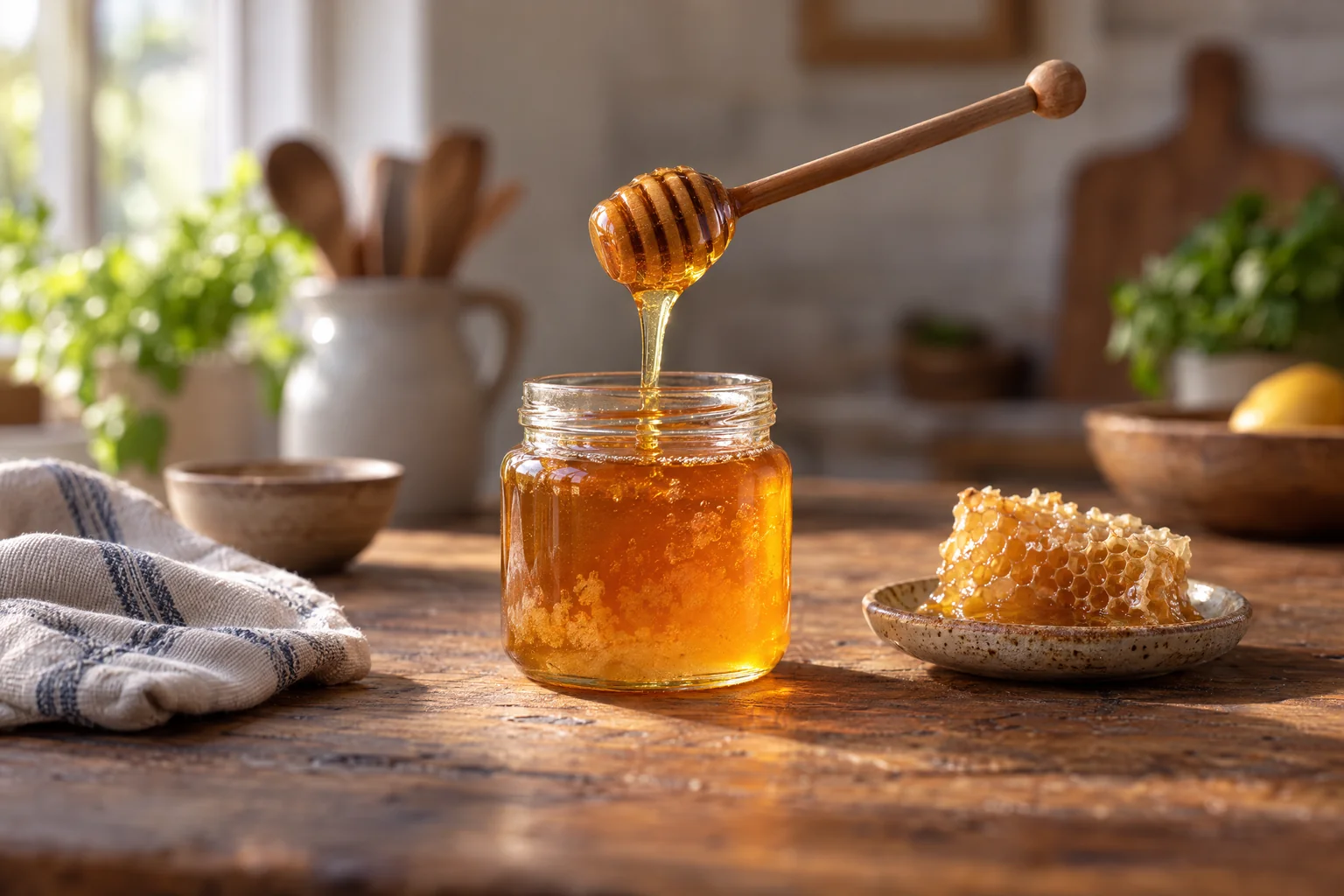
Honey keeps for years thanks to three defences: very little water, natural acidity, and a mild antiseptic that bees add themselves. But its one weak spot is moisture — sealing the jar matters more than chilling it.
Answer
There is probably a jar of honey in your kitchen that has been sitting there for years. It may have turned darker, and there may be hard grains at the bottom. But it still smells sweet. People often say honey is the one food that never goes bad — and that archaeologists once opened a jar of honey from a pyramid, three thousand years old, and it was still good to eat.
Bad news first: that pyramid story is not true. Wikipedia is blunt about it. No edible honey has ever been found in Egyptian tombs. The things that were called "ancient honey" turned out to be other substances, or just chemical traces.
Good news: honey really does last a very long time. It has three defences. The first is very little water. Ripe honey is only about 18% water, packed with so much sugar that there is almost no room left. That thick sugar syrup actually pulls water out of bacteria, so microbes cannot survive. The second is acid: honey is naturally acidic, and most bacteria cannot handle it. The third is the cleverest. Glands in a bee's throat make an enzyme called glucose oxidase. It gets mixed into the honey and slowly turns a little of the sugar into hydrogen peroxide — the same stuff people use to clean wounds.
But honey has one weak spot: moisture. Honey is hygroscopic, which means it grabs water straight out of the air. If the lid is loose, the water content can climb above 25%. Then the yeast that is already hiding in the honey wakes up, turns sugar into alcohol and gas, and the honey starts to taste sour and bubble. That is when it is truly spoiled.
So storing honey is easy: keep the lid tight, keep it somewhere cool, and never dip in a wet spoon. If it turns grainy, that is not spoilage — it is just sugar coming out of solution.
One more thing worth knowing: babies under one year old should never eat honey. Honey can carry Clostridium botulinum spores. A grown-up's gut can hold them down. A baby's cannot.
Try this at home. Put one spoonful of honey on each of two small saucers. Leave one open next to the kitchen sink, where the air is damp, and put the other in a cupboard with a cover on it. After three days, rub a drop from each between your fingers. The open one will feel runnier and stickier. You have just watched honey drink the air.
Michael's Thought
So honey is not magic. It is just winning a long fight against water in the air. From now on I am drying the spoon before I dip it in.
Sources
Related WHYS

Why does eating pineapple make your tongue feel like it is being bitten?
It is not the sourness. Pineapple carries enzymes that cut proteins — and your tongue is made of protein. The same enzymes stop gelatine jelly from setting, yet cannot touch agar.

Why does cilantro taste like soap to some people?
Cilantro leaves get their smell from aldehydes, the same family of molecules found in soap. Whether you taste soap or freshness depends on a smell-receptor gene called OR6A2.
Why does bread go hard while biscuits go soft?
The bread is losing water while the biscuit is gaining it. In the same cupboard, two baked things are running the same process in opposite directions.