2 min
Why do we hiccup, and why can't we stop?
A hiccup is not a random twitch: the diaphragm jerks, then the glottis snaps shut about 35 milliseconds later, cutting off the air. Hiccups have been recorded only in mammals — and tadpoles use almost the same reflex to push water over their gills.

Answer
Have you ever been sitting quietly when suddenly — hic! — and then again, and again? The more you want them to stop, the harder they seem to come.
The sound does not come from the twitch. It comes from a door slamming shut. A muscle called the diaphragm sits across the bottom of your chest. It jerks on its own, and you take a tiny breath in. About 35 milliseconds later, the glottis — the gap between your vocal cords — snaps closed. The air gets cut off. That is the hic. So a hiccup is really a breath that gets grabbed halfway.
Its history is even stranger. A hiccup is not a random spasm; it is a complete reflex with a very steady rhythm. Babies hiccup before they are born, and the nerves that make hiccups work grow earlier than the nerves that make normal breathing work. Premature babies spend about 2.5% of their time hiccuping. Hiccups have been recorded only in mammals — cats, rats, rabbits, dogs and horses — and tadpoles use almost the same simple reflex to push water over their gills. Both are switched off by higher carbon dioxide in the blood, and both can be stopped by the same kind of medicine.
So there are two ideas. One says hiccups help a nursing baby push swallowed air out of its stomach, making room for more milk. The other says hiccups are a leftover from the gill-breathing of our amphibian ancestors. Both are still just ideas.
Try it at home: next time you hiccup, hold your breath and take slow sips of water — the holding is the important part. Holding your breath raises the carbon dioxide in your blood, and that is exactly what switches hiccups off. Then ask someone to count the seconds between each hic. You will find the gaps are surprisingly even, because this is a reflex, not random shaking. (Do not put a paper or plastic bag over your head. That is dangerous.)
Michael's Thought
So when I hiccup, my body is doing something it already knew how to do ages ago. I just still have the button.
Sources
Related WHYS

Why does a mint candy feel icy cold when it is just room temperature?
A mint candy cools nothing down, yet it feels like ice. Menthol simply flips the body's cold switch, TRPM8, so the brain receives a fake message that says cold.
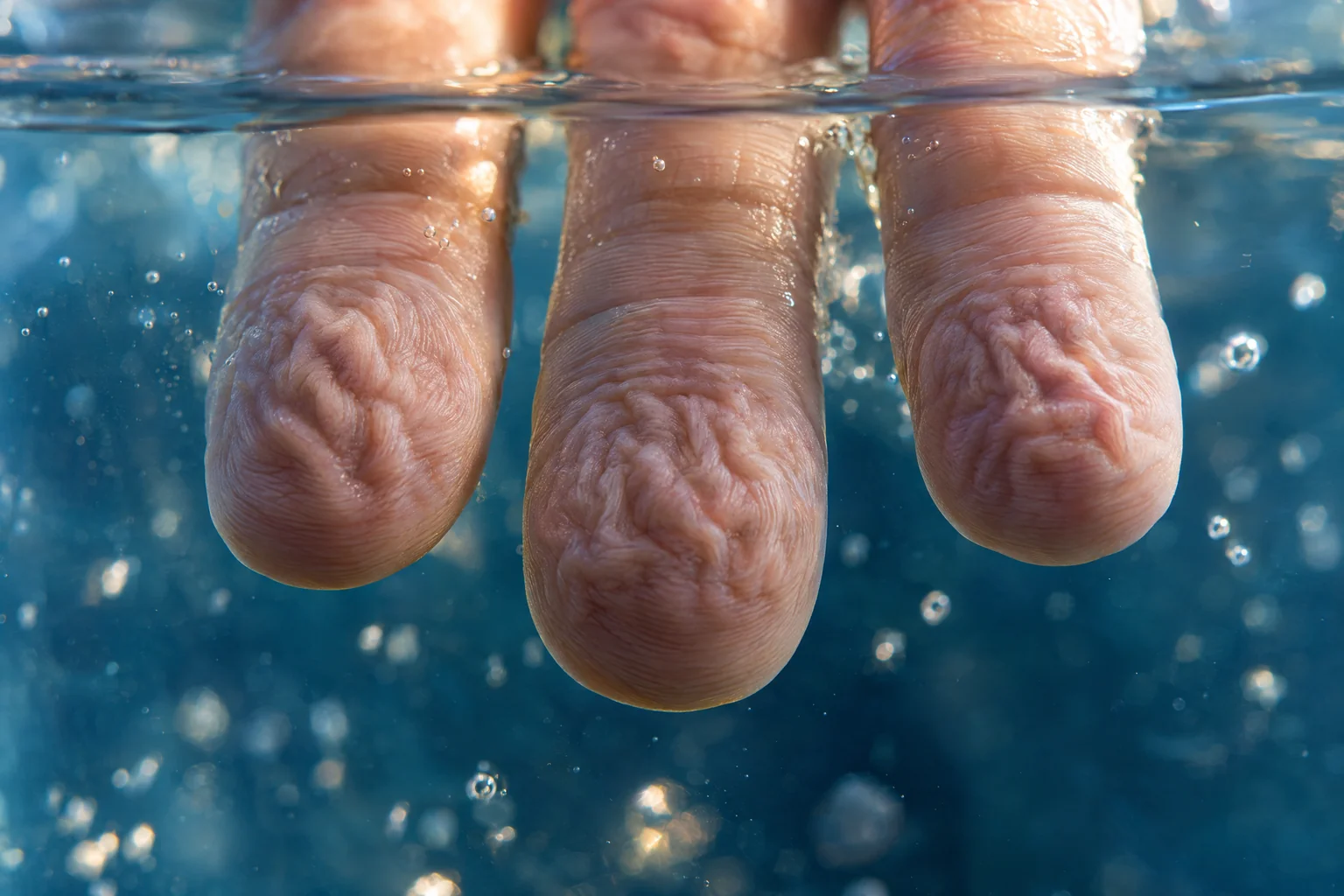
Why do your fingers wrinkle in water?
Wrinkly fingers are not swollen skin. Your nerves tell the blood vessels underneath to squeeze shut, the fluid is pulled away, and the skin sinks into folds. Nerve-injury patients gave the secret away back in 1935.

Why does looking at my phone in the car make me feel sick?
Your inner ear says "we are moving" while your eyes say "we are not". When two senses disagree, your brain falls back on its oldest safety program: nausea. Carsickness is not weakness — it is a wrong button.