3 min
Why do soldiers wave a white flag?
A white flag belongs to no country, and no treaty says it must be white. The reason it was chosen is surprisingly simple — and it did not always mean surrender.
Answer
Something strange on the battlefield
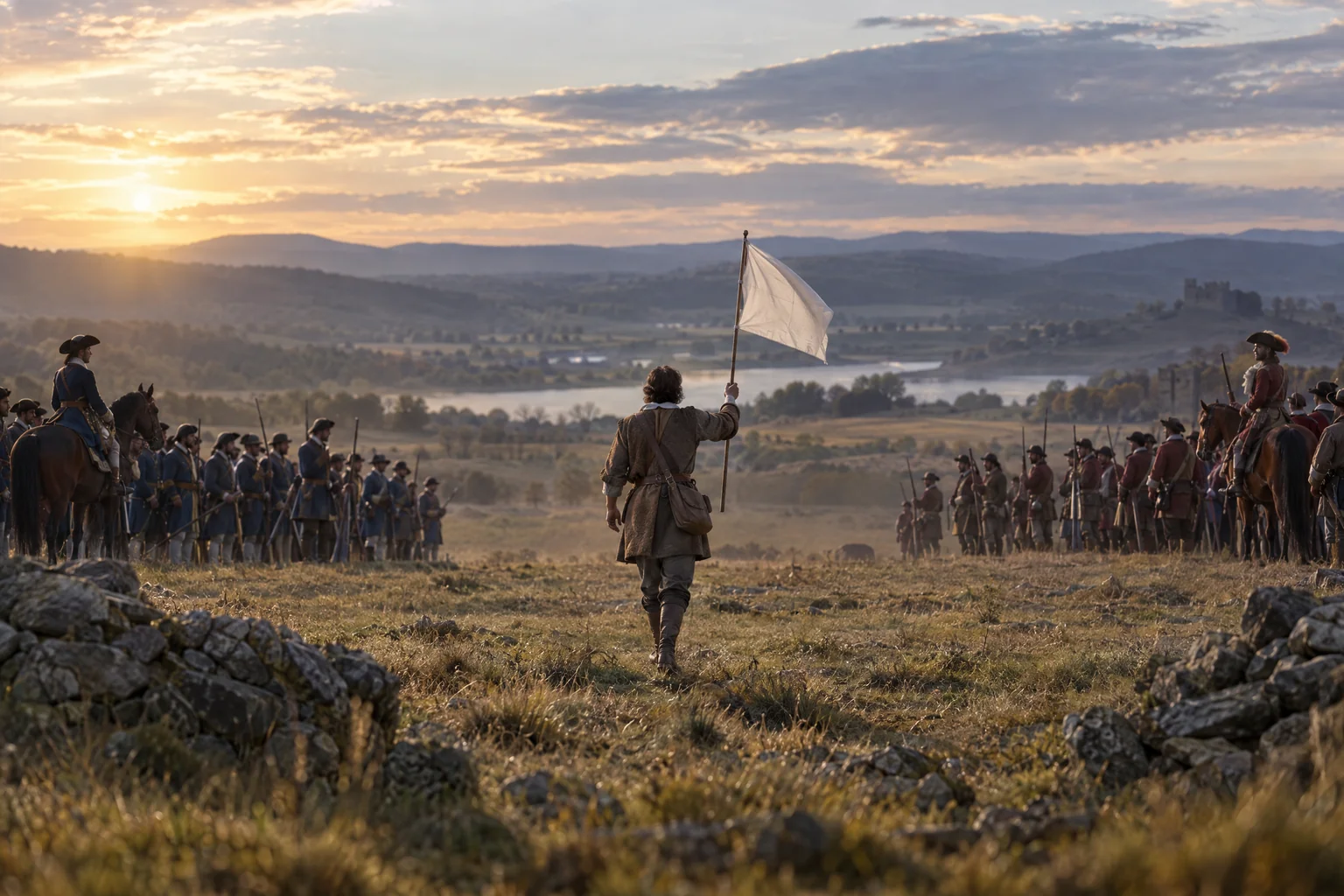
Two armies are fighting. Guns are firing. Then one side holds up a white flag — and the shooting stops.
But that flag belongs to no country. No treaty says it has to be white. Everyone on Earth recognises it anyway, because of a habit we have kept for thousands of years.
Why white?
For three very simple reasons:
- It costs nothing. An army would never pack special "surrender supplies." White needs no dye — a white shirt, a white sheet, or a shirt-tail torn off and tied to a stick works fine.
- It is easy to see. A battlefield is a mess of brown dirt, green grass, grey smoke and mud. A patch of white can be spotted hundreds of metres away.
- It says nothing. White carries no crest and no country. It is a blank page. All it means is: right now, I am not going to fight.
It did not always mean "I give up"
Here is the surprising part. The white flag first meant "I want to talk to you."
In China, during the Eastern Han dynasty (25–220 CE), people already used white flags to ask for surrender. The Roman writer Tacitus mentioned one in 109 CE. And in 1625 a Dutch lawyer named Hugo Grotius wrote in On the Law of War and Peace that a white flag is an agreed sign asking for a parley — a talk — and that it works just like saying the words out loud.
In 1899 and 1907, the Hague Conventions turned that habit into law. The person who carries a white flag is called a parlementaire. He must not be attacked, and neither may the bugler, drummer or interpreter who walks with him.
The rule works both ways. Shooting at someone carrying a white flag is a war crime. So is pretending to surrender and then attacking. But the flag-carrier may not shoot either.
Try it yourself
Hang two shirts on the same line — one white, one dark. Ask a family member to stand at the far end of the room, or across the street, and say which one they can see first. Then try again on a cloudy day, or somewhere dusty. White always wins.
Michael's Thought
I always thought a white flag meant "I lose." It really just means "wait — I want to say something." And both sides actually stop shooting for it.
Sources
Related WHYS
Why do barbershops have a red, white and blue spinning pole?
That spinning pole outside a barbershop is not decoration. It is the old sign of a barber-surgeon: the pole is the stick the patient gripped, the top basin held leeches, and the bottom one caught the blood.
Why do coins have ridged edges?
Those tiny ridges on a coin's edge are not decoration. Long ago a coin was worth the metal inside it, so people shaved silver off the edges and spent the coins anyway. The ridges make any missing metal easy to spot — and the Latin words pressed into the edge literally mean "an ornament and a safeguard".
Why is an hour 60 minutes long, and a day 24 hours?
Twenty-four hours and sixty minutes came from two different ancient civilisations — Egypt's twelve star-groups and Babylon's base-60 counting. A quick bean experiment shows why 60 was so handy.