2 min
Why does milk come in a square carton and cola in a round bottle?
Milk wins on expensive space; cola wins on pressure. The shape of a package is not a design choice — it is a cost calculation.
Answer
You see both every week. But why is one square and the other round, when both hold liquid? The answer is hiding in two different kinds of cost.
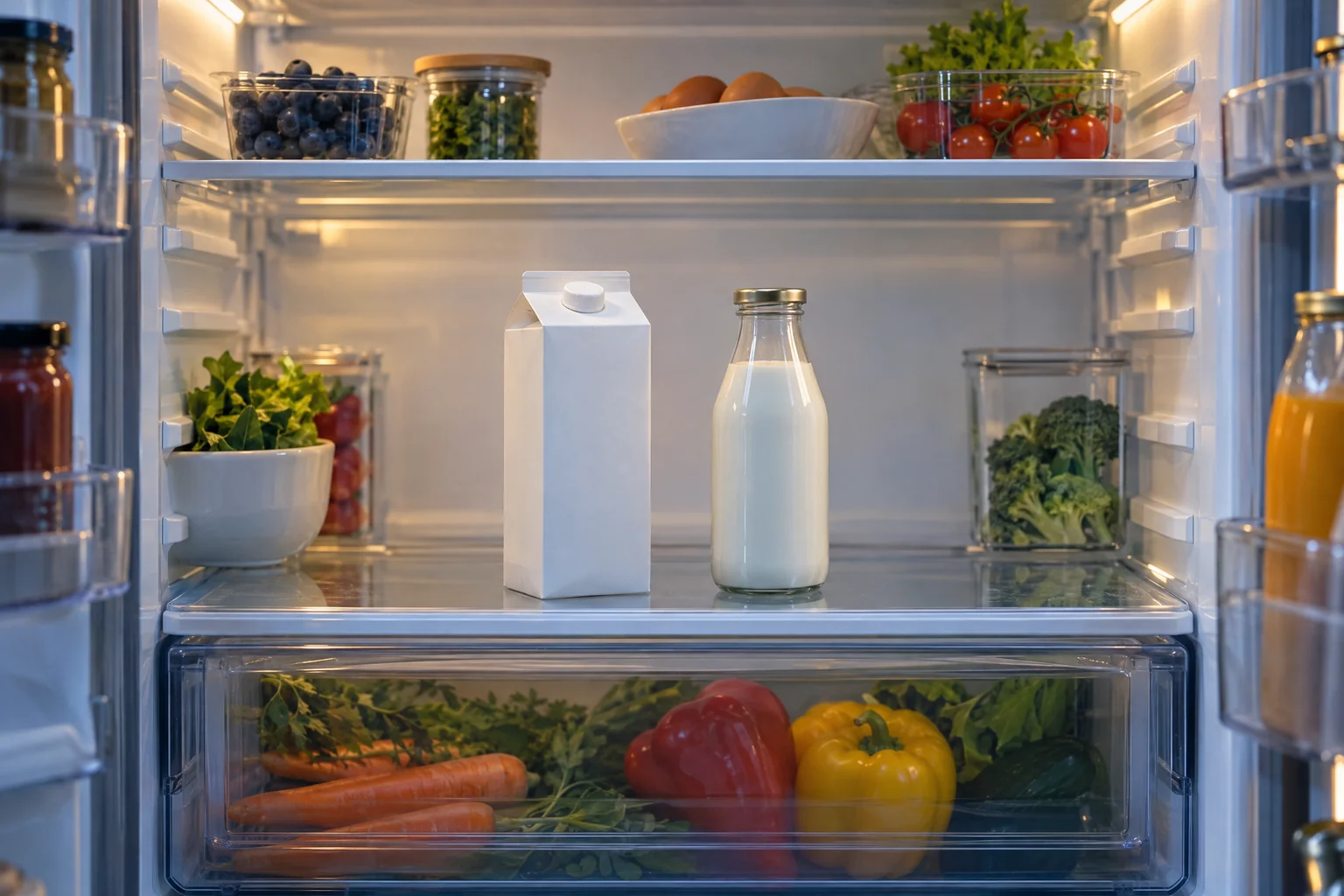
Milk wins on expensive space. Milk spoils, so it needs refrigeration from the farm to your fridge — and chilled shelf space is the most expensive space in a supermarket. A square uses 100% of it. Round bottles leave about 21% of the space empty, and that is pure geometry: a circle inside a square wastes 1 − π/4, which is about 21.5%. Milk also comes in paper-based packaging, and card is stiff, folds neatly into a square, and stacks tightly for transport. Square wins.
Cola wins on pressure. A fizzy drink bottle holds two to four times normal air pressure. A cylinder spreads that force evenly, with no sharp corners where stress can pile up — it is the strongest shape for the job. Make it square and the corners are where it will split. On top of that, blowing glass or PET into a round bottle is simpler and more reliable, and it fits your hand better.
In one line: milk wins on expensive space, cola wins on pressure. The shape is not about looking nice — it is a cost calculation you can hold in your hand.
A stranger fact: a cola can is a cylinder for exactly the same reason as the bottle — pressure. And if you forced a milk carton into a round shape, the card would lose its supporting edges, the forces would spread unevenly, and the seal would be more likely to fail.
Michael's Thought
So the square and the circle were not chosen by a designer — they were calculated from cost. Next time I am in a supermarket I will look at the shapes first.
Sources
Related WHYS
Why is a wedding ring worn on the ring finger? — And why the 'vein of love' is not real
People say the wedding ring goes on the left ring finger because a vein runs from it straight to the heart. That vein does not exist. The rule was actually written down in the English Book of Common Prayer in 1662.

Why do we put candles on a birthday cake and blow them out?
The popular story about ancient Greek cakes for the moon goddess doesn't hold up. The version we can actually trace starts with 18th-century German birthday parties — and blowing out the candles, a 2017 study found, adds about 14 times more bacteria to the cake.

Why do we clink glasses when we toast?
Clinking glasses probably has nothing to do with poison — there is no real evidence for that story. It looks like a secular leftover of ancient offerings, and the word "toast" first meant spiced bread in wine, then the person honoured by the drink.